Category Archives: Japan

Copy This Scribble That Feel the Pain

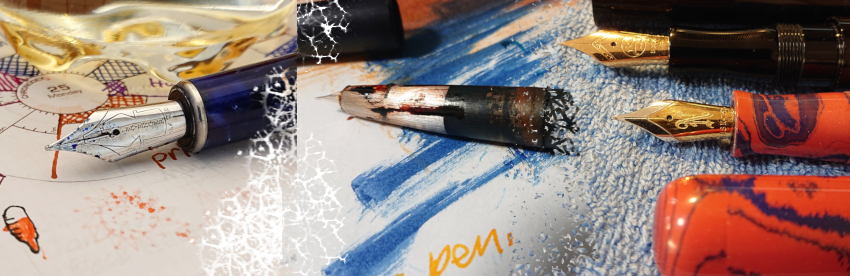
Because I have, perhaps, an unhealthy interest in pens, it was only natural that after I came to Japan I would start playing with brushes.

Through a Japanese colleague who piqued my interest, and because I thought it would help me learn Japanese, I began studying shodo, or Japanese calligraphy. This involved acquiring some equipment (which the teacher was more than happy to sell me).  I needed brushes, a couple felt pads, a weight, some bottled ink, some ink sticks, a grinding stone and a lot of Japanese paper.

Each lesson started with me pouring some liquid ink on a grind stone and then darkening it with an ink stick. When it was ready, my teacher (whose name I’ve completely blanked on as I sit down to write this) would hand me the day’s lesson. I would then force myself into something resembling seiza and begin my practice. (To understand what it’s like to use a brush, hold a long pencil with a proper grip, but up by the eraser. Then hold the pencil straight up and down and try to write your name.)

I started with a kids’ book but she quickly realized I was serious and I moved on to higher level characters. For example, I might have these four characters: 雪山千里. I would copy them, using proper stroke order and technique (the first character has 11 strokes and starts at the top.) My teacher would then take out a brush loaded with orange ink and mark my mistakes. If I was correct, she would circle it. Eventually I’d do a test version that would be sent off to some evaluation committee that would rank me in a way similar to karate ranks.

Early on, I asked my teacher what a certain group of characters meant. She basically asked why the hell I needed to know what they meant; I just needed to copy them. 雪山千里, for example means, Snow Mountain Long Distance and apparently comes from a poem, but I’ll never know. This left me in the odd position of focusing on language simply as movement and form but not as meaning. Wondrous philosophical, that. Useless in getting a date with a Japanese woman, though. (Check it out, sweetheart, I can totally scribble the hell out of this piece of paper.)

Eventually I moved on to the cursive, or KANA, version of the characters. There was a small version, but my favorite involved a meter long piece of paper and a lot more pain as I crawled around on the floor. The cursive characters look a lot like the start of a Jackson Pollock painting when he was only dribbling black paint and cigarette ash. I still like this version the best because it has more flow and style than the block letters. Unfortunately, for all their apparent haste and sloppiness, they are no less precise than the block letters and my teacher spent a lot of time marking them up with orange ink.

In this style, I eventually earned a ranking. I even adopted a pen (er, brush) name and got an official stamp. My “official” name was 旅人道延, or Tabibito Doen (the latter pronounced very close to Dwayne). It stands for, more or less, “The Traveler’s Road Stretches.” (Another post that.)

However, after several cancelled practices on both our parts, I started attending a second night of karate instead and stopped studying calligraphy. I still have better handwriting in Japanese than I do in English. It just has no meaning.
Beer Whiskey Rice and Thongs but No Candy Bars

It is an odd quirk of Japan that you can buy almost anything from a vending machine except, well, for things we usually expect from vending machines.

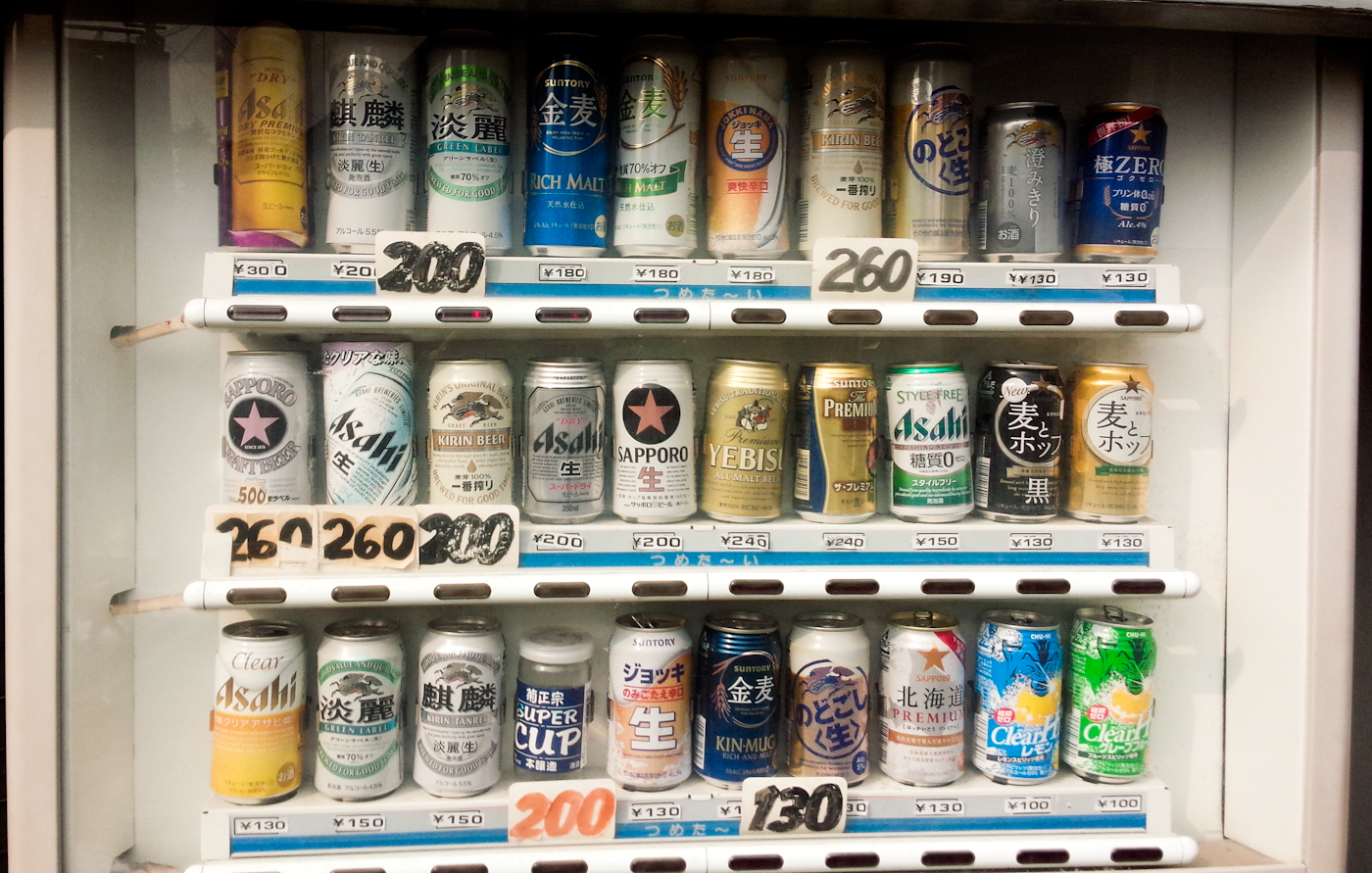
One of the first things lonely and bored foreigners discover upon their arrival in Japan, especially if they live in rural areas, is the local beer vending machine. I’ve seen grown men reduced to tears upon seeing these.

Beer and beer variants with a sake Super Cup and a couple ChuHai.

A typical beer machine with beer and beer variants. Also present are a sake Super Cup and a couple ChuHais.

I was even more impressed when I found a machine that allowed me to buy a fifth of whiskey and a two liter bottle of sake. It’s also possible to buy chuhai, which is a kind of like vodka and soda mixed with fruit juice.

Mostly ChuHai with a lone sake at the bottom center and a couple whiskey high balls bottom right.

Mostly ChuHai with a lone sake at the bottom center and a couple whiskey highballs bottom right. The sign on the right warns minors not to buy these items. (As if THAT would ever happen…)

I’ve also seen vending machines that offered kerosene; five kilogram (11 pound) bags of rice; individual roses; flower arrangements; complete hot meals of hamburgers and French fries (coming soon to the $15 minimum wage city near you); ice cream; soup; and women’s underwear. (More on that later.) You can also get soft drinks, including canned coffee. During the winter, some drink slots serve hot coffee and hot canned soup.

In fact, the only thing you can’t find with any consistency is a candy bar. That has begun to change though as some train stations, to save money money on staff, have been switching from kiosks (kind of like a newsstand) to candy machines.

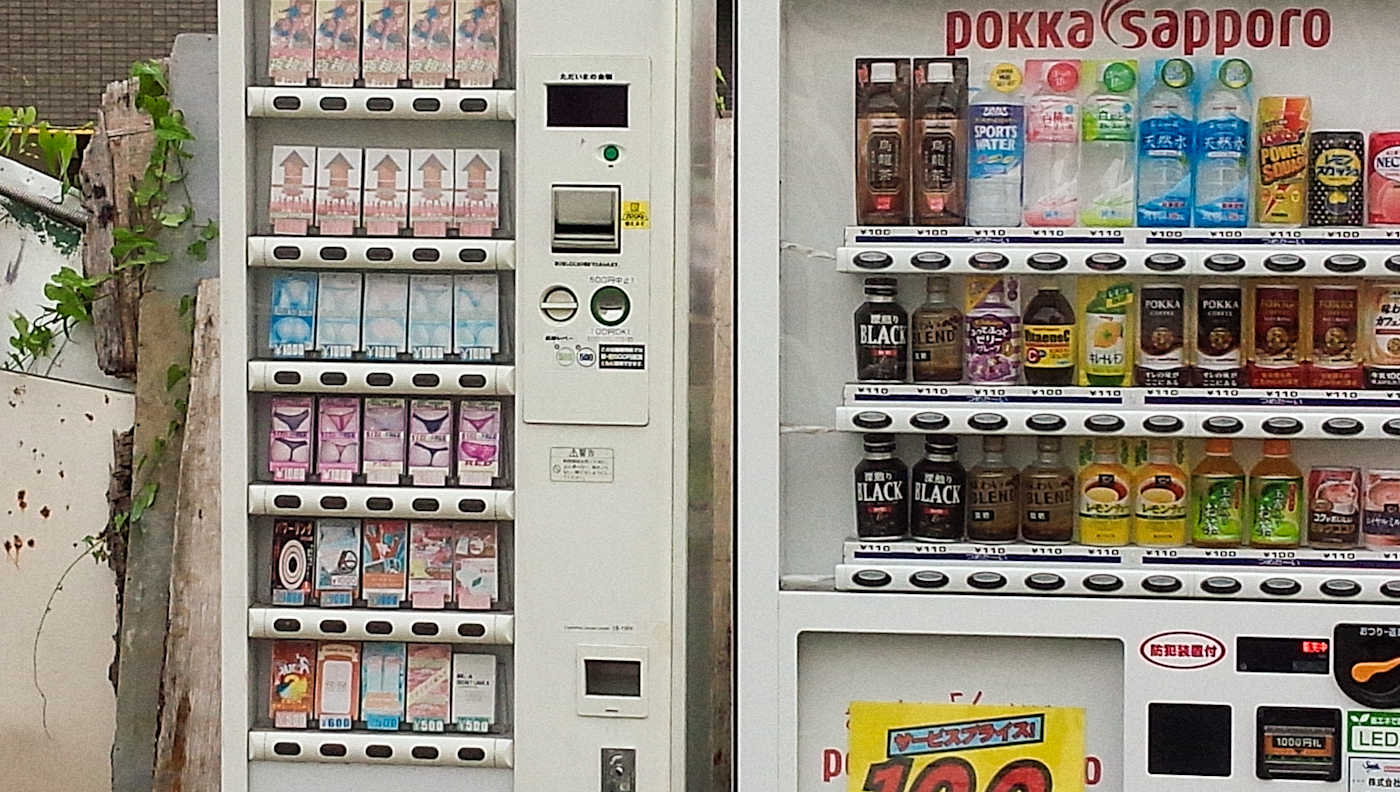
For a while one of the vending machines near my house offered a dodgy gambling game where for 1,000 yen ($10ish) you had a chance to win an iPod nano, an iPhone, or a random piece of cheap Chinese made crap. Now it sells, um, intimacy related products right next to the soft drinks.

Soft drinks on the right and, um, soft core on the left.

One of these things is not like the other. Soft drinks on the right and, um, soft core (?) on the left.

There are, of course, a few rules. The beer machines usually shut down at 11 p.m., purportedly to keep minors from buying alcohol after hours. (Because, see, none of them would think of buying it at, say, 10:30.) Several years ago, under pressure from the government, and to keep teens from buying alcohol, the All Japan Liquor Merchants Association called for a voluntary ban on alcohol machines resulting in 70% of the machines being shut down. (I’m sure this had nothing, NOTHING to do with pressure from convenience stores.)

The newest trend, is touch screen vending machines which are both cool and kind of creepy. Especially if they ever start using them to sell, um, intimacy related products.


Some Things are Exotic, Some Things are Just Wrong

Strangely enough, curry has followed me a good portion of my adult life. I had roommates from India who pretty much gave me a crash course in Indian cooking and, according to my friends, pretty much made me smell as if I lived in a curry restaurant.

Then, soon after I arrived in Japan, I was invited to an Indian cooking lesson. The couple from India taught the gathered group how to make authentic curry by first cooking down onions and then adding lots of other tasty stuff (my apologies for the technical terms) and eventually producing curry. I asked the man, who had done the bulk of the cooking, where the best curry restaurant in Japan was. He said there wasn’t one. He was from northern India and most of the curry restaurants in Japan served Southern, coconut milk based curry.

The Japanese have their own version of curry which is basically a curry flavored demi-glace served on rice and which is traditionally considered an abomination by those who come from countries famous for traditional curry (England, Scotland, large parts of Europe, for example). Yet, a few years ago, a Japanese TV show sent expatriates from curry producing countries such as India, Pakistan, Thailand etcetera around Japan to find the most authentic curry. They returned with curry omurice, which is rice covered with an omelet covered in Japanese curry sauce. (Omurice is short for “omelet rice”). The Japanese panel was underwhelmed and pointed out that purpose of the exercise was to find the best example authentic curry in Japan and the entire expatriate panel basically said there wasn’t one but they liked the (to them) unusual flavors of the curry omurice.

This is an experience that I’ve mostly got used to in my travels. Somethings are just wrong (eggs, tuna, mayonnaise, and shrimp on pizza, for example) and somethings miss the point (the Japanese referring to “hamburger steak” as a “hamburger) and somethings are adventurous at first then normal (using leftover Japanese curry to make curry udon, for example).

The rest of the world gets revenge when the Japanese go abroad. What has been done to sushi so upset the Japanese Ministry of Agriculture that in 2006 they started sending undercover agents to Japanese restaurants around the world to test the authenticity of the cuisine and give a rating. (What a great scam; how can I get a government job that sends me around the world eating things? I fear the authenticity of Kansas City Strips in steak restaurants. Please send me around the world to test and rate them.)

The bad press from the sushi police and, I suspect, the tastiness of the international variations caused the Ministry to backtrack and say the focus was on safe preparation and, dammit, we should be able to build a school to teach locals how to do it right, whilst considering local tastes.

Once again, how do I get that job?


The Road To Hell Denied As Long As Possible

As Pleasant gives way to Humid/Hell, our family starts an unusual game of money saving endurance tinged with denial. I also am forced to give my students fair warning.

Basically our plan is to put off using our air conditioners as long as possible. Energy, even after the earthquake and tsunami and subsequent irratio-political battles over nuclear power, is still reasonably cheap in Japan. However, as cheap as it is, we are even cheaper (in a different sense of the word).

As the first step we take toward humid/hell, we put off taking out our fans. Granted, this is partly because the storage closet in the “variety room” (“junk room” is too strong a phrase as not everything in the room is junk) is hidden behind the variety pile. Taking out the fans thus requires a bit of rearranging, lots of washing of heavy blankets and the washing of the cover of the electric carpet. All of this is then folded and stuffed away with the kerosene heater whilst the fans are carefully assembled and the empty boxes returned to the storage closet.

We then endure the increasing humidity with fans and open windows for as long as possible. Our goal is to get as close to July as possible without having to use our air conditioners. (Note: most of Japan uses Split AC systems rather than central air, which means we have different ones for the living room and the bedroom.)

Once we end our denial, getting the air conditioners ready involves spraying them with cleaner and then running them to make sure the drain hoses still drain. (One year the living room one didn’t; temporary hilarity ensued. And a lot of wiping.)

We then use the fans to try and move air around. The variety room, where I do most of my “work” has no AC and I commandeer a fan to keep it coolish.

Then winter rolls around and the process operates in reverse.

As for my students, the new school building where I work is impressive but is also bright because it has lots of windows (translation: it’s a big greenhouse). Students therefore battle each other over the proper temperature. My basic rule is they lose five points for every degree above 24 Celsius (about 75 Fahrenheit). The highest ever was when someone set the temperature for 30 Celsius (86 Fahrenheit). I pointed out that when the temperature reached 30 we usually turned the air conditioner on. I then deducted 30 points from the guilty students final score.

We just took out our fans. Our journey to hell is well under way.


Crushing Together for Drink and Food

Another late one, which means another drunk blog. We’ve got to stop meeting like this.

Tonight, as a kind of welcome party for my new colleagues, a few of us headed over to Saitama-city (the capitol of Saitama Prefecture) for the Japan Craft Beer Festival. I had stumbled across this annual event a few years ago when I was on my way to a night class. I had to go to the immigration office nearby and then headed over to a Hawaiian hamburger place. Along the way I stumbled across several kiosks serving exotic beer. Although I’m not a huge beer fan, I do appreciate a good ale and a good stout. I therefore started singing something like “oh sweet mystery of life at last I’ve found thee” but then remembered I was on my way to work. I therefore did some quick math involving time and blood alcohol levels and molecular decay and then got confused by all the math and decided it was best not to drink anything.

This time, though, I arrived early and was immediately freaked out by the crowds. Thousands of people had assembled and most of them had brought tarps to set out on the sidewalk under the trees. Hundreds of them had brought their children and forced them to participate in a large drunken picnic. I bought a beer and some fried chicken from a brewer connected to one of my friends and muscled my way into a place to set my food and drink. One American Style India Pale Ale from Brimmer Brewing later I felt a lot better about the crowd. I went and had dinner and did some shopping and then came back and met my friends. The crowd didn’t get smaller–in defense of the crowd it was a great night to be outside drinking beer.

We then proceeded to drink our way across a good portion of Japan. Craft beers, or micro-breweries are a relatively new concept in Japan. Before 1994 in order to get a brewing license a brewer had to produce about 528,000 barrels of beer. After 1994 the amount changed to around 500 barrels and micro-breweries began appearing around the country.

One of the things I like about craft beers is you can drink several and never drink the same flavor. Even the same beer from the same brewer can vary from year to year. The major brewers in the USA are kind of like McDonalds: the menu is pretty much always the same always tastes the same and you pretty much know what you’re going to get. Craft beer is more risky, mostly because the brewers actually take risks.

The second beer was a House India Pale Ale from Shiga Kogen Brewery. It had a strong hoppy flavor that created an instant craving for salt. We then got a four pack from Hakone Brewery. We liked them all but the stout was too heavy for a summer night. We then experimented with WineRed from Virgo Beer. This was a fruity, wine flavored gruesome concoction that reminded me of a spritzer made with beer. It actually got better as it warmed.

Towards the end, a friend of a friend did a suicide by mixing all the unfinished beers on the railing (we never got a seat; we just seized a portion of the railing). The result was surprisingly tasty, which told me I’d had enough to drink and it was time to go home.

Despite the crowd and the copious amounts of alcohol I didn’t notice any problems. There was one security guard walking around with a glowing baton acting as if he was in charge of the crowd. We all laughed at him because just the drunk foreigners present–and there was one guy there in a pirate outfit–could have ripped him to pieces and then gone for more beer. We didn’t know whether to mock him or buy him a beer.


I Can See Blurry Now the News is On

One of my favorite quirks of Japanese TV is its absurd dedication to privacy and secrecy. The dedication is serious enough that the people involved seem to forget television is a visual medium.

The first thing they do is that they crop the neighbors when they interview them for the “He seemed like such a nice guy for a man who walked around his yard in tighty whities and a gas mask and carried a machete.” quote. They usually focus on the chest, even if the person volunteered to speak. Sometimes they even disguise the voice.

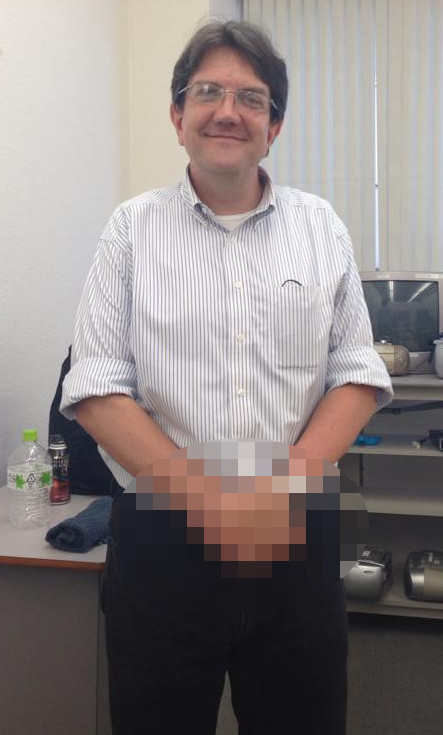
The next example is that, for some reason, TV news is not allowed to show handcuffs on an arrested suspect. I’ve been told this is so that people don’t think the suspect is guilty. Keep in mind, the suspect is stepping out of a police car, is surrounded by dozens of police officers and is being escorted into a police station, but if we see handcuffs, we might think he’s guilty. (Or as my friend Charles once said “Perhaps he’s discovered the cure for cancer…”)

Why is this crim, er, man smiling?

Really, does the mosaic make this crimi-, er this man, look innocent?

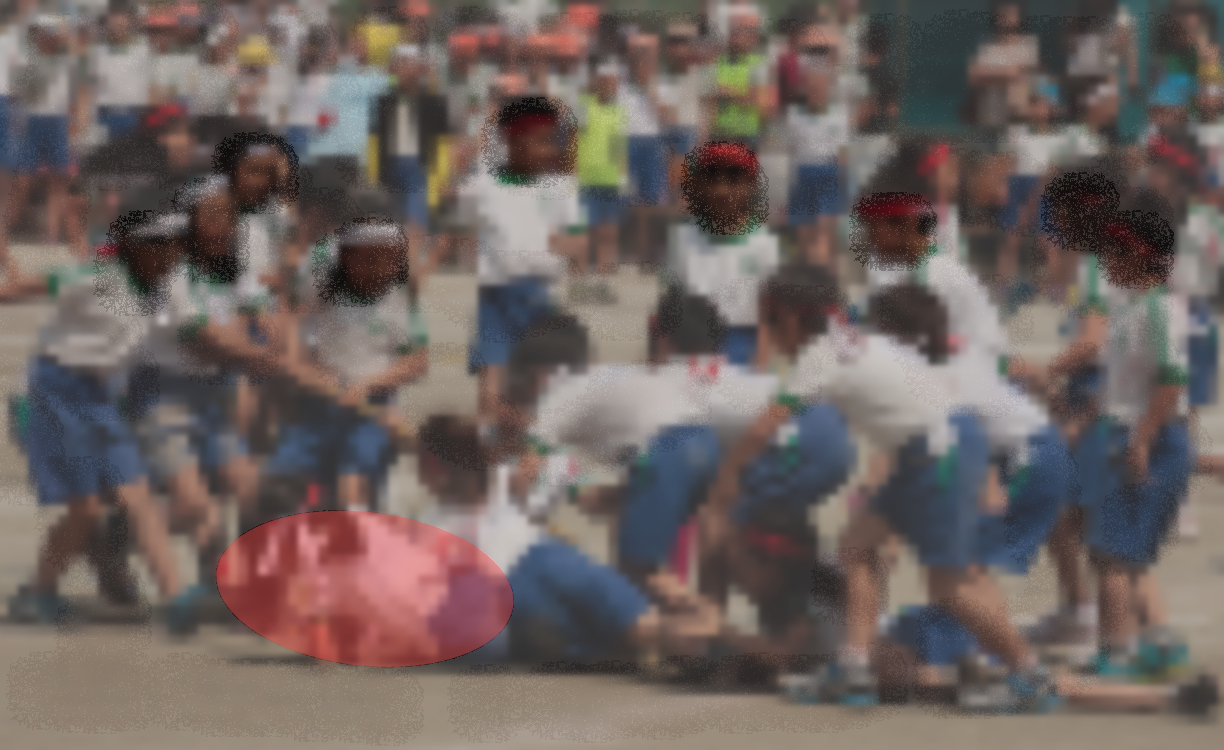
The third thing they do is that they will blur out almost every thing on a screen to hide the faces of bystanders and to hide the story’s location. Sometimes one fragment of the screen will be clear or they will highlight the important bit, so that you can follow that something important is happening even if you can’t see it.

Very important things are happening here, as you can clearly see.

Very important things are happening here, as you can clearly see.

One of my favorite news broadcasts of all time was a sting operation to catch a serial train groper in the act. As bait, they used a female police officer dressed in a school girl outfit and pretty much every one in the car was a police officer. As the events unfolded every centimeter of the train car was blurred to hide the location and the inside was blurred to hide the identities of the police, the few non-police and the suspect. The actual crime occurred under a different colored blur and then there was lots of shouting–with computer distorted voice–from out of the blur and then the blur moved out onto the train platform.

The effect was the same as listening to news on a radio whilst watching the static on a dead TV channel and calling it TV news. And yet it was oddly fascinating.

Once Wedded Thrice Ceremonied

Fourteen years ago today I married She Who Must Be Obeyed after some paperwork, a bit of confusion and a small temper tantrum. We count that as our first wedding ceremony and our official anniversary. Ten months later we’d finally be finished having weddings.

The initial confusion was a result of us actually researching the issue of marriage rather than following our instincts. The instructions seemed simple: bring paperwork XYZ for both partners and the foreign guy needs to bring his Residence Card. In neither the English nor the Japanese instructions we read (from different sources) was a passport mentioned. In fact, for foreigners with visas, the Residence Card and not the passport is considered the official ID. We packed up all our stuff–sans passport–and headed to Niigata for our marriage.

Of course, local officials immediately demanded a passport. We showed every instruction and guide book we had, in two languages, and that my passport number was, in fact, on my Residence Card. After careful consideration, the staff sent us away and went off, we thought, to process our marriage documents. We returned a while later to find the man we’d been arguing with talking on a phone. I cringed for a moment because I feared we were about to encounter wakarimasen dekimasen and The Phone Rule. Unfortunately I was correct.

A few minutes after that, the official showed us a passage in a book that said they could accept a passport. We then entered a brief Bible Verse Context Debate. I pointed out the passage before that passage stated that the passport could be accepted IF NO OTHER ID EXISTED. They said: “Yeah, how about that. Passport please.” We filled out everything we could and, once I got home, I mailed a copy of my passport to them and they backdated our marriage to May 26th.

About three months after that we flew to the USA and brought along She Who Must Be Obeyed’s family (known as They Who Look At Dwayne And Shake Their Heads And Sigh). We had a church ceremony after events that, like all things to that point, involved bureaucracy and my late paternal grandmother leaving her church over their bull– er, their bureaucracy. The church we ended up in, though, was great and everyone had a great time. Everyone decided that my brother-in-law was actually Jackie Chan and he exploited the confusion for a great many free drinks and a part in at least one straight to video movie (something like that). We then had a nice honeymoon, minus They Who Look At Dwayne And Shake Their Heads And Sigh, in Vancouver, Canada.

Finally, in March of 2001, we brought my mother and step-father over to Japan for our Japanese ceremony. From what I’ve heard, the Japanese ceremony and reception were great and that my mom actually sang for the first time in years. However, Japanese custom required She Who Must Be Obeyed and me to miss most of the ceremony whilst we changed clothes. It was one of those situations where everyone is all smiles as you bow and exit the room and then once the doors are closed the smiles disappear and they start shouting “move your ass move your ass clock is ticking clock is ticking you’re not the only one getting married here today maggots move your ass move your ass.”

My years of acting classes had prepared me for quick changes and putting on smiles for the crowd as soon as the door opens. However, it didn’t prepare me for missing my own wedding dinner. Granted, they brought food out for us, but then the speeches started which meant we weren’t supposed to eat. Luckily, my short 10 days in Air Force Officer’s Training School taught me to eat fast, meaning I actually got to finish my meal. Although they would bring the scraps to our hotel room, She Who Must Be Obeyed never actually got her entire meal. Instead she got stuck with me which, well, yeah. Well.

We then had two beautiful girls who, after some careful discussion, especially recently, we’ve decided to keep. At least for now.

Brief Fits of Violence and Horror

Yesterday I talked about the different types of parents at sports day. Today I thought I should talk about sports day itself.

My first taste of sports day happened my first few months in Japan. I was invited to attend in a way that made it seem as if my attendance was optional. However, as an Assistant Language Teacher working for the school board, I felt it was my duty to attend and, because I was still in the early glow of being in Japan, I was looking forward to attending. Then I got to school and one of my teachers said “I see you’re participating in the shototoshobugubugu  and in the tsunabunatikihiki.” (not their real names) I went “huh?” and then figured out I was running the obstacle course and the taking part in the tug-o-war.

I’ve mentioned before that, partly thanks to acting, I have a bum knee and pointed out that, in fact, I had a limp and that I shouldn’t be involved in a running race, especially when jumping on and over stuff was involved. I also pointed out that I thought it was optional and didn’t understand why I was scheduled for events. They shrugged and said “ganbatte” which usually means “don’t give up” but in this case meant “Stop bitching and start stretching. You’ve got a race to run.”

The obstacle course involved moving 10 beans from one plate to another with chopsticks, hurdling a bar and crawling under another, crawling under a cargo net, running across a balance beam, fetching a piece of candy out of a tin of flour using only my face (not a joke), running around the track with the candy in my mouth and my face, eyes and lungs covered in flour, jumping on and over a vaulting horse, and then limping to the finish. The tug of war involved teachers and parents and went reasonably well for the other team.

What fascinated and horrified me the most, though, was the surprisingly violent nature of a lot of the sports. At one junior high school there was a tire grab where students rushed to several tires and tried to drag them back to their side. People got knocked down and stepped on and lots of skin was scraped off hands as tires were yanked away. In another event, called kibasen, three students carry a fourth whose job it is to grab a hat or bandana off the heads of rival students. Tempers flare, hair gets yanked out, some students abandon the pretext of grabbing the bandana and simply start pummeling their rivals.

At another junior high, groups of boys held up bamboo poles with flags on them and then formed pyramids that reinforced the flagpoles. Teams of girls then fought to pull down and or capture the opponent’s flag. This involved girls knocking girls down before they could reach the pyramid, girls jumping on the backs of boys in the pyramids to get more height, girls pulling girls down off the pyramid and dumping them in the dirt, and years of bad blood coming out. In once case, a girl was knocked out cold when got pushed backward off the pyramid and hit the back of her head square on the knee of another girl.

The school nurse saw the girl wasn’t moving, ran out into the game, which was still going on, slung the girl over her back and carried her away from the game without checking her once. Now, I appreciate roughhousing as much as the next person–and I’m still shocked that it’s the usually sedate Japanese doing these violent sports–but dragging an unconscious person off the field while play is still going on, causes even me to have a sense of decency.

Some schools have tamed some of the events–students usually grab large hats now instead of bandanas–but there’s still a lot of roughhousing to be had. Even in the elementary school events, my youngest had a bamboo pole grabbed out of her hand and was later dragged across the dirt by several stronger kids.

Neither Mercy Nor Respect Nor Scrap of Human Decency

Most parents I’ve met in my life have seemed like decent people. However, one of the things I’ve learned in my Daddyhood is that no matter who the parents are, no matter what they do in life, all parents transform into either aggressive jerks or complete morons during an elementary school sports day. (Actually, there’s a third category, but we’ll get to that.) This is especially true in Japan.

The first transformation occurs before the event begins. If it’s scheduled to start at 8:40 a.m., you will see parents roaming the field at 7:30 or 8:00 so they can mark territory with blue tarps. (At some of the more prestigious schools, parents camp out overnight for the best spots.)  In our case, aggressive jerks lay out blue tarps and weight them down with a bag or a couple bottles of water and then disappear until the starting time. There’s no requirement that a person actually be there, the blue tarp holds the spot.

Once people arrive, you really see the transformation. Complete morons arrive in funny hats and/or long sleeve jackets to protect themselves from the sun. Children are allowed to run across other people’s blue tarps. At the start of events, the complete morons rush to their places, thus blocking sight lines for other parents. They then realize they chose a bad spot and rush off to a new location, upsetting even more sight lines.

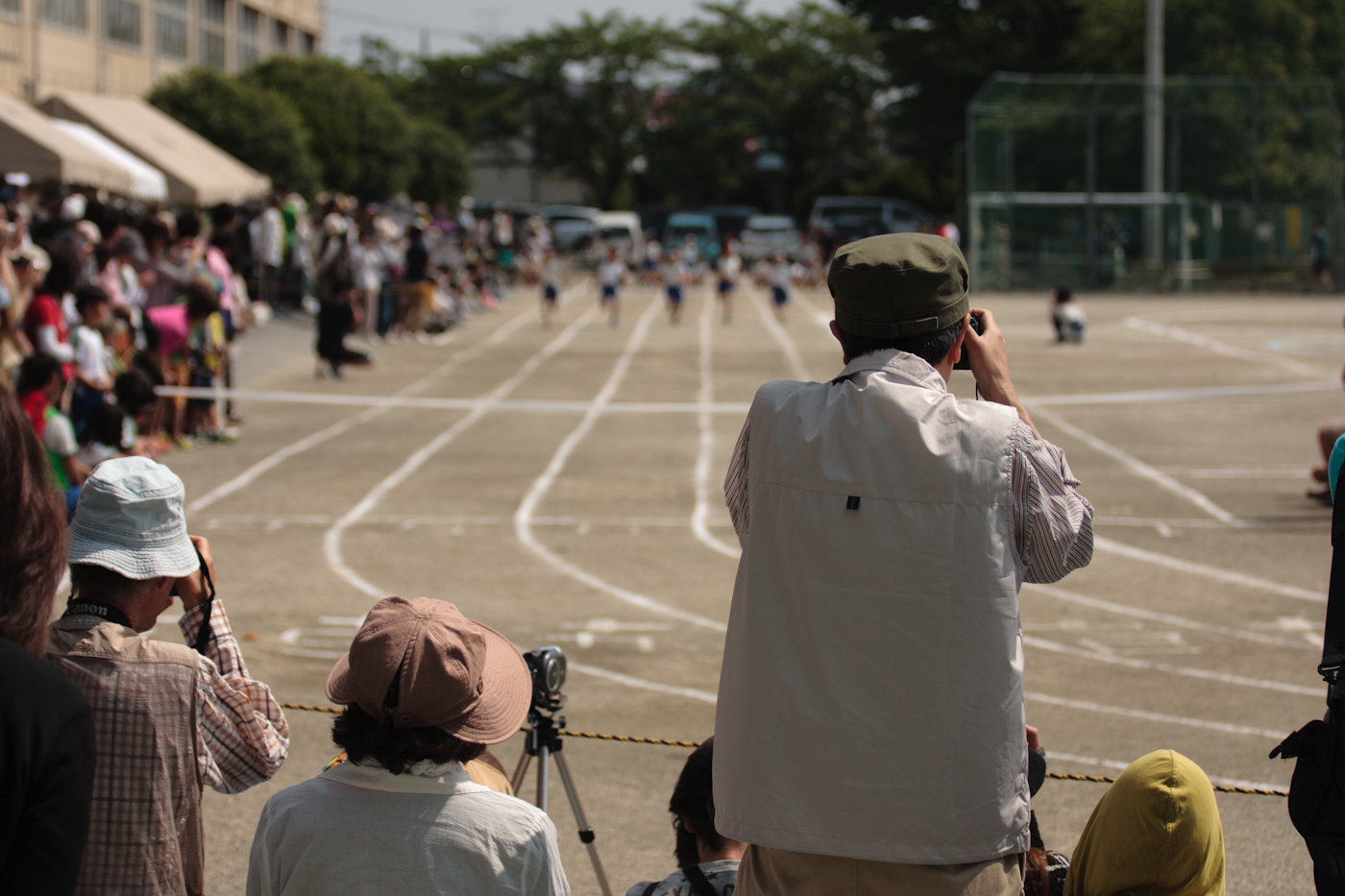
This is also time for the arrival of the aggressive jerks. In the photo areas, they force their way to the front, they set up tripods and they bump other aggressive jerks’ tripods. The taller they are, the more likely they are to forget that tall people don’t need to be at the front because they can see over short people. They talk loudly so the only thing you can hear on the video is the sound of complete morons talking about how some people are aggressive jerks. The worst are the parents and grand-parents of first graders attending their first sports day. They rise to a special level of aggression and will not be denied. They are not the worst, though. They are merely inexperienced, which makes them complete morons.

When you combine aggressive jerk with complete moron you get the third category: asshole. The asshole is seated close to the front, with a great view of the action, but stands up because he doesn’t understand that standing up doesn’t bring the picture closer, the zoom lens does. The asshole also doesn’t understand that the zoom lens works just as well whilst you’re sitting. This causes other assholes to stand up while some aggressive jerk behind them shouts, in another language, “sit down, asshole.” because he forgot to ask his wife how to say “down in front” in Japanese.

Asshole.

Asshole.

Most people are aggressive jerks when their child is on the field, but quickly excuse themselves or sit down once the heat is over. The asshole, though, will remain standing long after most others have sat down.

That said, for the most part, the sports days at my youngest’s elementary school are pretty painless. Unfortunately, I’m required to get mad at someone, and therefore be an aggressive jerk, at least once per sports day or the day isn’t complete. I’m also one of the morons wearing a funny hat

This is an example of a moron.

Moron.


Darkling Dreaming Teacher

I’m willing to bet that, no matter who they are and how soft-spoken and mild-mannered they are, no matter how much they enjoy teaching and no matter how dedicated to their profession they are, every teacher has dreamed of telling off a student.

I have lived that dream. Kind of. In a way. Rather disturbingly in retrospect.

It happened the end of my first year teaching in Japan. Japanese public school classes are much noisier than most Westerners expect. As I’ve said before, school is often considered social time and teachers tolerate an amount of noise that would trigger meetings and therapy sessions in the USA. Some weeks you can handle it and getting the attention of the class is a game; the next week culture shock sets in and you get angry and frustrated and you start shouting a lot.

In my case, the second wave of culture shock hit in June. For reasons I don’t fully understand, Japanese school years run well into July instead of ending at the end of May when God intended them to end. (I can’t remember the exact verse; And I say unto thee, go thee forth from thy school when the wind turneth as to the South and prosper ye about merrily in thine own way but mostly in Mine.) Something like that.

The weather was getting muggy and hot and my decades of conditioning resisted being in class that late. None of the student rooms were air conditioned.The result was not pretty, although it was kind of fun. I was teaching first year junior high (7th grade) and trying to help a girl during who was finally speaking to me. She’d asked a question and I was there to help her. The boy next to her, though, kept butting in with the answer and what she was doing wrong as she was trying to talk.

Finally, something snapped in my head. I asked the little shi, er, LAD, “Are you an English teacher?” After a couple rounds of “huh?” and me repeating, my Japanese English Teacher finally translated my question. “Are you an English teacher?” He went “No. No. No.” and I said “Then shut the fuck up.”

The teacher translated it as “Please be quiet sit down” in a tone that said “Please be quiet sit the hell down before the insane foreigner loses his last thread of sanity.”

To this day I have mixed feelings about that incident. He was trying to be helpful and I could have reacted in a different way. On the other hand, the young lass had the floor and he was stepping on it. Either way, after my initial feeling of horror and “Did I just say that out loud?” I realized it was kind of fun and actually felt good to say that.

I haven’t done it since. I’ve already lived that dream.