Category Archives: Japan

Vaguely Dangerous and Totally Fun

We spent the day at a nearby park watching our youngest do dangerous things on playground equipment that’s probably illegal in most parts of the USA.

One of the things I like about Japan is that a lot of playgrounds and parks still have equipment that require a certain amount of common sense and provide a certain amount of danger. Tall jungle gyms–one park we like to visit has a 12 foot tall rope jungle gym; merry-go-rounds; tall slides; swings with no “seat belts”; and balance beams.

In fact, the only thing I see lacking is a tall Witch’s Hat with no inhibitor like we used to have on the playground of Edison Elementary School in Hayden, Colorado. I remember getting a hand and leg smashed every now and then but nothing horrible. We also had a rickety, splintery wood and pipe merry-go-round that could get up to a fair speed. (A good tether ball set would be nice, too.)

The best part, though, was the swings. We’d get swinging as high as possible and then jump out. (Hey, I said a “certain amount of common sense” was required, not a certain amount of good sense and/or intelligence.) I remember one guy coming off the swing with his feet pointing straight up at the sky. He managed to get them down before he landed.

When we visited Florida several years ago, I was appalled at the squishy safe playground equipment. Even the ground had been rubberized. It all reminded me of the play things you put in a hamster cage.

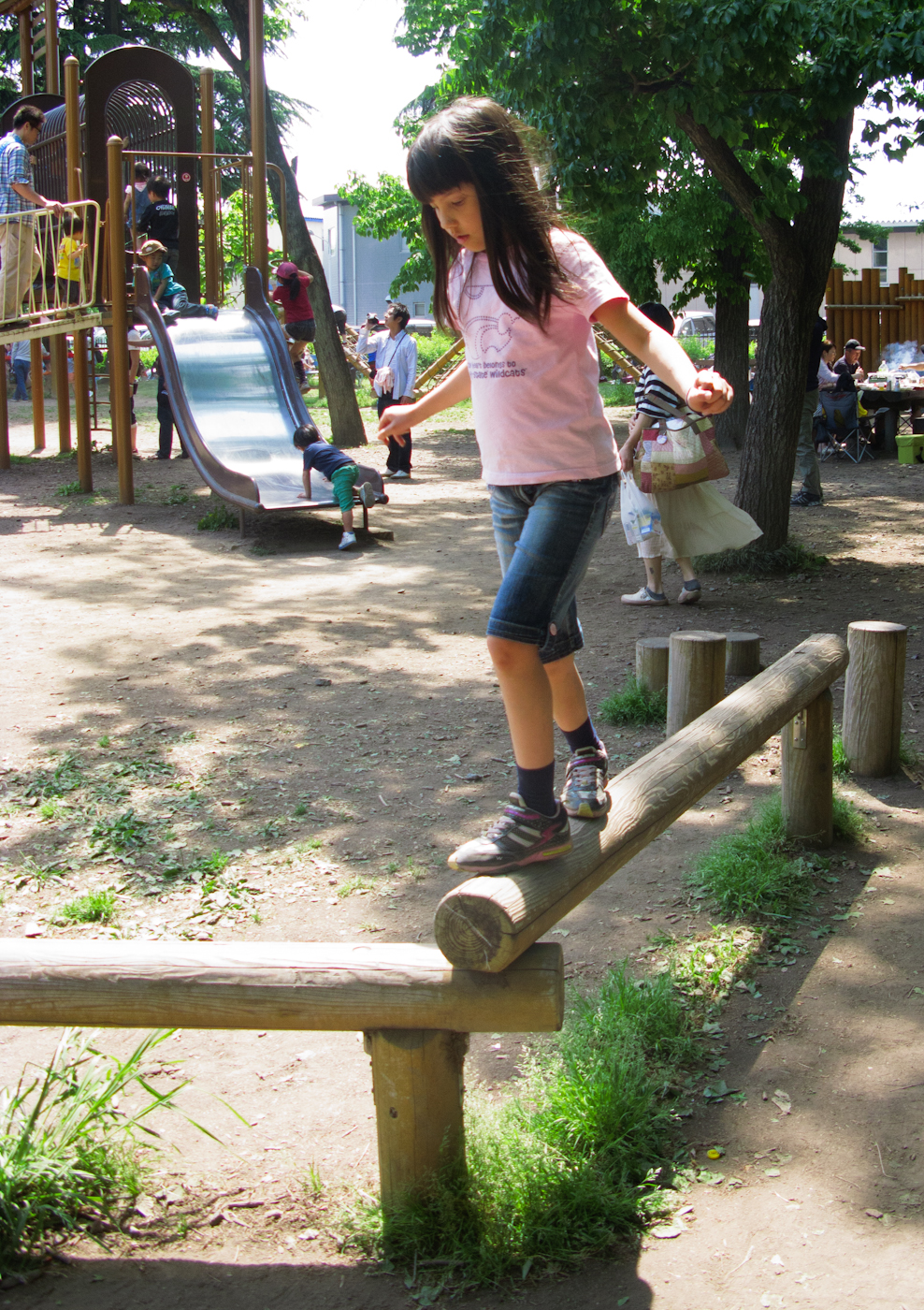
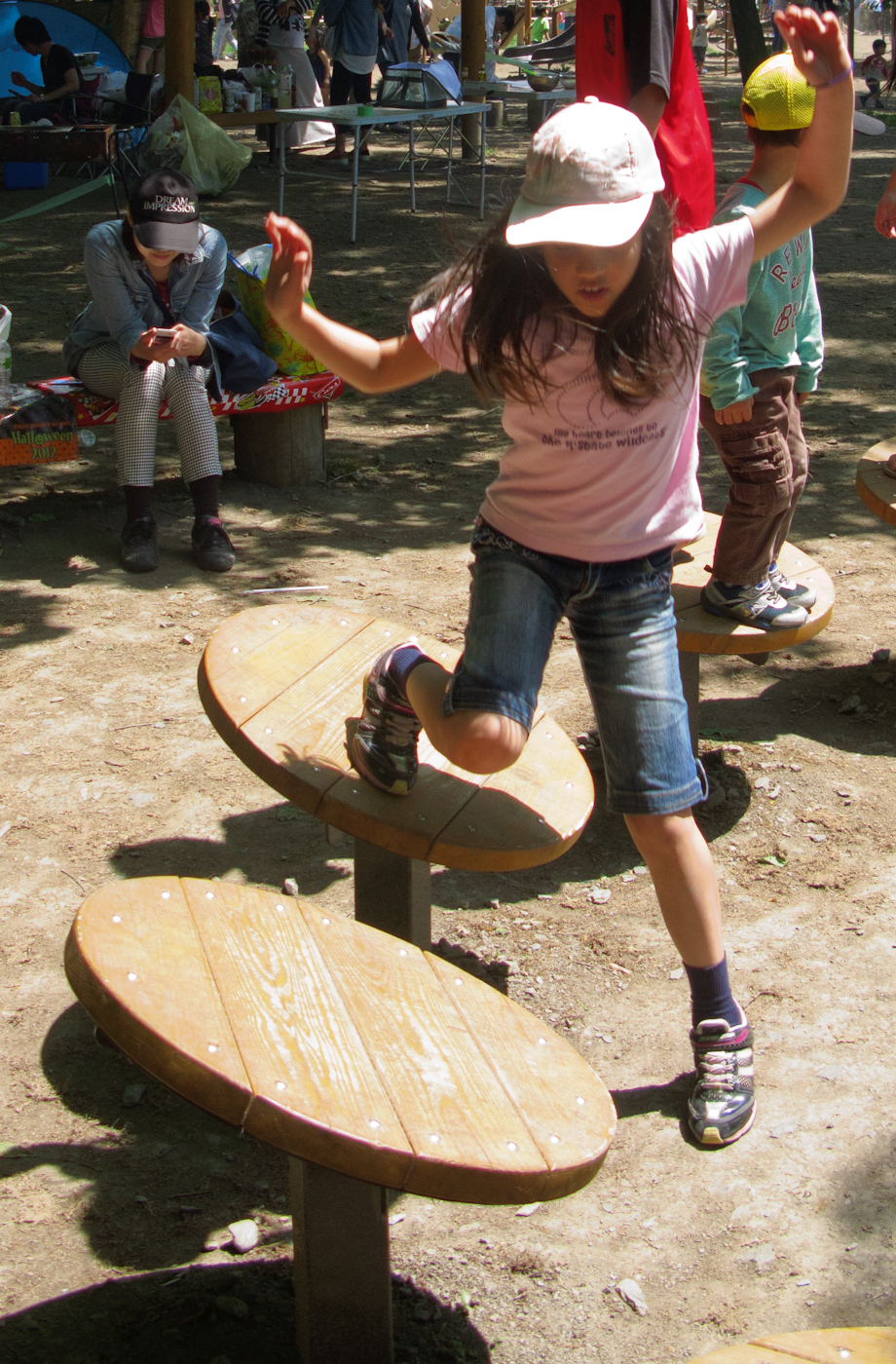
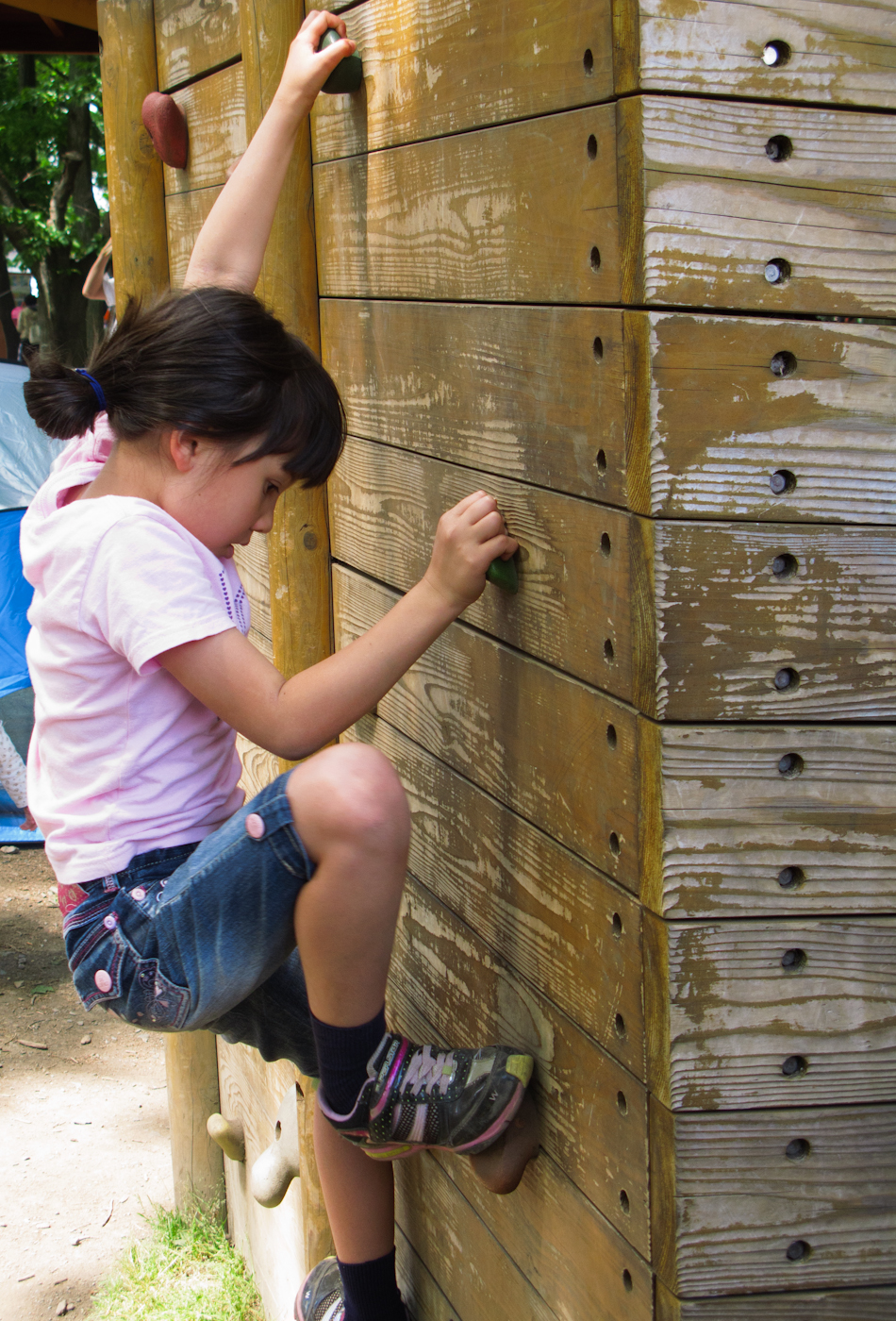
Today, though, I saw one little girl carrying a handful of dirt to show her parents. I saw a boy trying to hit his brother because his brother had knocked him off the raised discs. I also watched my daughter climb and fall off stuff and have a good time doing it. She tried the climbing wall; the swinging log path; the balance beam; the rope ladder climbs; and a few other potentially dangerous things.

ParkDay-5 ParkDay-3 ParkDay-1

The worst thing that happened, besides dirt, was she got chocolate on her butt. We’re still not sure how, but she’s eight, so it’s pretty much expected.


Bumping Bicycles and License to Kill

I’ve written before about how little annoyances can slowly wear on you when you live overseas. Now I see that a tube strike in London has put a swarm of amateur cyclists in the streets and this has reminded of two regional annoyances here in Japan: Bumping into people and people on bicycles trying to kill you and your family.

The former seems unique to the Joetsu area of Niigata Prefecture. When I visited Takada Park for cherry blossom viewing, I had five different people bump into with me within the first 60 feet of entering. I’m not talking light bumps or just brushing against me, I’m talking full on shoulder to chest collisions followed by looks of “What the hell?” from both parties involved (although my look was more “What the f@#k are you doing?”) Keep in mind this was pre-smartphone so the colliders actually lifted their eyes to recognize I existed.

I also had a man collide with me while he was walking and talking to his friend in Itoigawa. I saw this one coming a half block away and delivered the devastating blow myself; which, in retrospect, kind of makes me the jerk. in my defense, we were against a wall and I couldn’t get out of the way, not that I would have because I was in a hurry to catch a train and my pizza was getting cold. (I try to be a good person; really, I do.) I’m sure he had an interesting story about the foreign jerk who ran into him.

Keep in mind, I’ve walked the streets of London during new year’s bachanalia and the streets of New York during rush hour and never been bumped into once. In Japan it may actually be a park-related thing as even in the Tokyo region, I’ve had people bump into my camera tripod when I had it slung over my shoulder during a photo walk.

I don’t know if it’s putting their focus on the cherry blossoms whilst moving and not focusing on the direction their moving or if there’s a vague sense that, whatever they’re doing, it’s my job to move.

In Tokyo, though, the enemy is people on bicycles. I’ve been hit several times, especially from behind, by people who feel that ringing the bell on their handle bars is either absolution from sin or a license to kill. Part of the problem is that in Tokyo people feel inclined to cycle on the sidewalk, now matter how narrow the sidewalk is.

That said, size doesn’t always matter, so to speak. After She Who Must Be Obeyed moved to Tokyo, we were walking toward the station to have dinner. Along the way we crossed over a canal bridge. We were against the rail and there was a good three meters of sidewalk between us and the road. Despite this, a woman on a bicycle decided ringing the bell gave her permission to pass between us. At the last second, right as I jumped out of the way, she finally turned toward the open area. She hit me first then swerved away and hit She Who Must Be Obeyed.

I responded with great maturity by shouting at her and stomping on her spokes and threatening to throw the bicycle in the canal. Luckily, She Who Must Be Obeyed convinced me it was probably a bad idea. I told the woman she should get her moronic f@#king ass on the street where it f@#king belonged. (No really, I DO try to be a good person.) I then realized I should probably check and see if my pregnant wife was okay. (She was.)

Once every couple of years, the news reports on police efforts to rein in people on bicycles. They ticket them for running lights and riding on sidewalks. I sit back with a bowl of popcorn and cheer.

Clarity of Raw Fish and Cellphone Vision

One of the more interesting and disturbing things about living overseas is seeing the changes when you go back to your home country. There are the usual things: everyone’s aged a bit; trees have grown out; wall colors have changed; and your favorite hangouts have closed. Although those changes can be disconcerting, what really surprised me is the changes in raw fish and communications that occurred while I was away.

Raw Fish:
When I left the USA in 1996, neither I nor practically anyone I knew, had ever tried raw fish (I’d eaten raw oysters at The Boston Sea Party in Denver, but that doesn’t count.) I was intrigued by the idea of eating raw fish and vowed that, sometime during my first year, I would try it. Then, on my first day in Nou-machi, I ate at my colleague’s house and the first dish she offered was a plate of sashimi. I was like “as well now as another time” and attacked the sashimi without mercy. (I subsequently spent a good amount of time learning to pick slippery stuff up with plastic chopsticks.) I liked all the food I was offered, although two of them gave me pause: squid, which is a bit like eating a slippery unsweet gummy bear, and salmon eggs, which I remember using as bait when we went fishing near two-mile bridge Hayden.

Now, raw fish in all its forms is one of my favorite Japanese dishes (raw horse is another, but that’s another post). However, I’m in the land of raw fish and such things aren’t that surprising. What did surprise me was returning to Salina, Kansas in the early aughts and seeing a Japanese restaurant that served sushi. While I was spinning my totem to see if I was dreaming, She Who Must Be Obeyed was going “Hurry up! They’ve rice! They’ve got rice!”

I’m still stunned such a thing would exist in the middle of Kansas, even for a brief time. I’m also a bit surprised that sushi has become as popular as it has nationally. When I left it was in the realm of wealthy jerks and pompous well-to-dos. Now, it seems to be as common as potato chips.

Cellphones:
Speaking of wealthy jerks and pompous well-to-dos, when I left the USA, they were the only ones who had cellphones. When I got to Japan cellphone use was more common, but it still had a small group of users. By 1999 it had exploded in Japan. I remember reading that there were something like 3,000,000 cellphones in use in the USA while Japan had 30,000,000 in use (which meant one in four Japanese had one). In Japan this was driven by shockingly expensive land-line installation prices so I wasn’t surprised. I got my first cellphone when I moved to Tokyo and having one made my job easier.

However, about the time I was in the USA trying to figure out if the sushi restaurant was real, I also noticed that several of my friends had cellphones. (And, for the record, they were not wealthy jerks or pompous well-to-dos, for the most part.) A few years later, even my mother had one and, in 2013, everyone had a smartphone.

Except me.

I’m now in the smartphone market, not out of any desire to be more high tech–and quite frankly, the cult-like devotion some people have toward their smartphones is somewhat disturbing–but because my eight year old clam shell phone is being held together by duct tape.

Screaming and Wailing and Annoyingly Cute

A nasty headache–oddly enough, not a migraine–kept me away from karate tonight, so instead of waxing on and off about sports, I’ll talk about Japanese television and, more specifically, Japanese news announcers and how annoying they can be.

US announcers can be annoying, but at least each is annoying in their own way. They are arrogant, ignorant, ignorantly arrogant, falsely profound and, if they do features for CBS Sunday Morning, incapable of speaking above a whisper or annoyingly comic.

The latter is more like Japanese announcers. The morning shows are populated by a mix of young women and older, usually heavy set, men. The men are there to provide, as near as I can tell, the air of serious newsishness, even as they make funny faces and wear silly ties. The young women, who are usually excellent news readers, mostly exist to display fashion and smile and nod when the men speak. (Their nicknames are “so desu” girls–or “That’s right” girls.)

When it comes to sports coverage, especially at the international level, the announcers, usually men, toss away any sense of neutrality and propriety and openly support the Japanese teams. Granted, other countries do this, but none do it as loudly as the Japanese. When the other team is close to scoring the announcers start shouting–not speaking loudly, shouting–Watch out! Watch out! It’s dangerous! It’s dangerous! Watch out! When Japan scores, or is even near the goal, they can barely be contained. (Think “Do you believe in miracles!? Yes!” at every scoring opportunity.)

This carries over into other news coverage where it’s clear that the reporters feel it’s their job to emphasize how interesting this all is. (In the USA, the reporters usually try to remind us how serious is all is and that you’re only seeing that on their channel, or if it’s CNN, to talk about missing planes.) The result is over the top emphasis and nearly clownish takes to the camera. Right now there’s a Japanese announcer traveling around Cambodia trying to get them to try odd Japanese products–and, I suspect, to get them to allow Japanese manufacturers to move there from China. One of his products is an impressive water purifying powder that clumps the mud and crap in water simply by stirring it and makes the water easier to filter. Unfortunately, his manic way of presenting it–this is SO AMAZING! Isn’t it? Isn’t it? It’s JAPANESE INNOVATION!–makes me hope he gets a bad case of the runs from the water.

Sometimes the reporters are clearly bored and clearly struggling to find something interesting to report on. (Look, here’s a big bowl of soup! Look, here’s another big bowl of soup, with slightly different ingredients!) Anything that goes wrong becomes a major issue. One year, a female announcer was covering a winter soup cook off somewhere up North-East. She couldn’t just taste the soup, she pondered it with great manic energy and it was always delicious (even if she made an obvious “this is what evil tastes like” face after trying it). At one point, she started shouting “It’s horrible! It’s horrible! What will they do!? What will they do!? What will they do!?” as she ran through the booths and the camera chased her and bounced around like a badly filmed movie. Her reaction was loud enough I was expecting a Russian/Chinese/North Korean invasion; an explosion; or the crash of the Hindenburg. She arrived at the location and the camera zoomed on a broken bottle of sake. Apparently it had been knocked over and now the chef had to get a new one. Ah, the humanity.

Finally, there are the weather girls. Although Japan has a few professional meteorologists presenting the weather, most are women hired for their annoying cuteness. (There’s cute and then there’s something so cute you want to slap it–r.e. Hello Kitty.) They usually adopt high, cartoon voices designed to mitigate the effects of bad weather and/or wrong predictions. They usually pout if the weather is bad, and if they’re wrong, they remind me of squeaky voiced comic Felicia Michaels who says her unusual voice helps get her out of problems: “I didn’t mean to sleep with your brother. He tricked me.

The same works for Japanese weather girls. “I didn’t mean to miss the spring snow storm. It tricked me.”
The Liniest Place on Earth

This weekend is the start of Golden Week here in Japan. This is a glorious period where four different national holidays all fall in the same week, including a block of three holidays in a row.

Unfortunately, because the holidays are based on the birthdays of late emperors (unofficially, of course) this is a holiday that shifts around and some years it’s awesome, some years it’s average. This year the block of three fall on Saturday, Sunday and Monday. Because one of the days falls on a Sunday, the government provides a substitute holiday on Tuesday. It doesn’t do the same for Saturday, though, because that’s a work day for many people. However, a Saturday holiday doesn’t help me and is therefore useless. (Bah humbug. Something like that.)

Many Japanese combine these days off with their paid holidays and do some traveling. The smart ones get out of the city and/or the country. The foolish ones go to Disneyland.

The Tokyo Disney Resorts (which are actually in Chiba, not Tokyo–this makes sense when you remember the New York Jets and New York Giants actually play in New Jersey) consist of Tokyo Disneyland, which looks a lot like the Disneyland in Anaheim, except is about three times as large, and the nautically themed Tokyo DisneySea, which is intended as a date spot and is the only Disney resort in the world that serves alcohol. The food there is awesome, too.

Unfortunately, they are also the most popular Disney resorts in the world and pretty much the entire population of Japan tries to squeeze in them during holidays. I’ve dubbed the place Tokyo DisneyLine, because pretty much all you do once you get there is stand in line and tell your children, “No, we are not there yet. We are yet hell and gone from there.” One time we had to wait 45 minutes just to get a Fast Pass that would let us cut the line at a popular ride. (Don’t you judge me; the stand-by line for the ride was over 90 minutes long.)

I remember a couple hundred years ago, I think on a high school trip when I was still living in Hayden, Colorado, we went to the Disneyland in Anaheim and, although we had to stand in line, I remember the Space Mountain line wandering around a performance area where Pat Boone was singing. If I remember correctly, he was putting on a surprisingly entertaining show (Although at that age, seeing someone you’ve seen on television is kind of cool no matter who it is.) Or that was the trip where we tried to smuggle my dad in the country via Tijuana, Mexico and our stuff got stolen out of our car in the Disneyland parking lot.

Tokyo DisneyLine has nothing like that, though (the small music performances, not the smuggling and theft). You just stand and move, move and stand, spend five minutes on the ride and then go stand in another line for 90 minutes for the next five minute ride. (There’s something disturbingly philosophical about that now that I think about it.)

The best time to go, though, is during school. You just play hookey and head down there. We did that once with our oldest and I got to ride Space Mountain three times in 20 minutes.

That’s a happy place to be.

Pro Patria Pro Deo Pro Coffee

As I’ve written before, I discovered coffee at university and my tastes evolved from gussied up dessert/coffee combinations to pretty much main-lining espresso doppios. I am quite willing to admit I’m an addict, don’t understand why you are not, and that I’m a bad person before I’ve had coffee (and only slightly better after). I’m also quite willing to admit that although I’m a reasonably patient person, the exceptions to that involve family, people who walk and smoke, a handful of Canadians, morons on bicycles and people who mess with coffee.

I bring this up because one of the cliches about Japan is that it’s a smoker’s heaven and a coffee drinker’s hell. At one point a cigarette company had a great commercial about smokers from the USA arriving on Japanese shores via makeshift boats and being welcomed by the locals with a pack of smokes. One town used to have a “tobacco tax” goal meter to encourage people to light up.

When I first arrived in Japan, though, there were only a few coffee shops around and I was shocked that, although the cake part of the Coffee and Cake Set was delicious, the coffee was a tiny little half cup that wasn’t even an espresso and that cost seven dollars.

Now, a few wishy-washy artistic types have argued that the half cup is special and that some Japanese have raised coffee making to the level of a martial art. They have carefully selected and hand-roasted the beans and carefully ground them in a burr grinder. Some of the beans have been carefully “processed” by civets (i.e. eaten and crapped out by civets). They boil carefully filtered water and pour it over the perfectly measured grounds which sit in a special canvas filter hand made from organic hemp by a 120 year old zen master in a secret location in the Japanese Alps. The coffee masters pour slowly until it seems as if the water is about to flow over the brim of the filter. Then they tap it and the water and coffee flow into the pot below.

At this point some people give polite little golf claps and say “That’s amazing. He’s a true artist. The coffee is beautiful.” while I’m in the back shouting “just pour the damned coffee!”

When the coffee is finally served it is typically half a glass. I’ve asked if it was just a sample and been told that, no that was my four dollar cup of cat poop coffee. (For the record, civet coffee is actually a hundred dollars a cup so I’ve never actually tried it, also, it’s cat poop.) I’ve also made them bring the pot out and add more coffee to the cup.

I did this in front of She Who Must Be Obeyed once and she was pretty close to walking out of the coffee shop. I told her I loved her and would do anything for her and that I’d catch up to her once I got my cup of coffee filled properly.

Mercifully, since those days, the Japanese have discovered coffee. This is important because, as shown in the book The Devil’s Cup, the strongest empires are those which hold coffee in high esteem. Once they switch to tea, they are doomed. (r.e. Turkish Empire, British Empire).  This also means that there are now many chains to choose from, including Starbucks which I never patronize outside of Japan, unless it’s in an airport. There are also some Japanese chains serving decent and cheap coffee now.

If there’s ever a ban on coffee, I will start my own mafia and smuggle it in. Well, at least as far as my house which, I admit, will make it hard for me to keep my goons well paid and well fed, but we’ll cross that bridge when we come to it.

I need a cup of coffee first.

Students and the Darndest Things

One of the interesting things about teaching at an all boys school is that I get to see, for better and for worse, the boys behaving the way boys behave when there are no girls around to impress. The homerooms are basically multi-resident bachelor pads that start out clean and get slowly grungier and grungier over the week.

The other interesting thing is that boys tend to forgive slights, both real and perceived, more easily than girls and they can be a lot more forward. As a result, many of them aren’t shy about confronting teachers and/or back talking. Usually, as a teacher, I adopt the rule comedians live by: never let a heckler have the last word. For example, when a student told me to shut up, which at least he did in English, I talked him out of the room–he seemed to think we were actually going to fight–and let him explain to his homeroom teacher why it was necessary for me to shut up.

Every now and then, though, one of them says something that I can’t help but let pass. They aren’t always confrontational, just different. The student who told me to shut up gave a funny, improvised speech about how he was the best speaker in Japan. He wasn’t going to get a good score because he hadn’t actually followed the assignment. However, I said he was right, he was the best speaker, and said he was going to the speech contest. His “Really? No no way” (in Japanese of course) was pretty funny, although perhaps not the way he expected.

Another student gave a speech about his skin, which he kept deliberately pale and sickly looking. Once again, it violated pretty much every requirement of the assignment, but was done well enough I let it pass.

In a less happy one, a kid in a lower level junior high class decided that because he didn’t understand what he was supposed to be doing, he was automatically granted free time. He put his book away and took out a pair of lighters and started playing with them. I confiscated the lighters and turned them into the homeroom teacher. The next class, after I called his name in roll I said “Gotta light.” he just mumbled “Fuck you” under his breath. Since I was the instigator, and since it was the most English he’d spoken in two classes, I let that one slide.

This one technically doesn’t count because it’s from a different school, but when I was back in Niigata, some of my students were returning from P.E. They’d been studying Judo and were still in their dogis. One boy looked an me, held up and flexed his arms like a body builder and said “I’m fighting for justice” and then went on down the hall.

My favorite, though, involved two high school boys who, because they were friends, always worked together on in-class projects. Work, in this case, being relative not literal as they spent most of their time messing around and talking. After a while, I told them that if they didn’t get their work done, they’d never be together again. The more flamboyant of the two looked me straight in the eye with feigned horror and said “Like Romeo and Juliet.” I laughed through something about not ending up like them, but I’d already lost that round.

The student lost points, of course, for not doing his work correctly, but it was a small victory for me as he probably never noticed.


What You Think You Know is Not Enough

I usually get a couple of questions when people find out I’ve been studying karate for a long time.

1) Have you registered  with the government as a deadly weapon yet?
Answer: No. I haven’t and I won’t. That was a temporary thing the occupying forces did after WWII.

2) Does that shit really work?
Answer: Yes; unfortunately, so does a lot of other shit.

3) You study sword defenses? Where the hell are you ever going to need to defend yourself against a sword?
Answer: Scotland.

The longer I’ve studied karate the more I’ve realized it’s best I stay out of fights. It is a sport/art for the small and fast. I’m neither. I’m pretty sure I could hold my own long enough to make an exit (which, by the way, is pretty much required by Japanese law: when you can get away, you are obligated to get away) but I also think it’s best I never try to prove that.

Part of this is the way my style–and I’m sure many others–teach the various techniques. For example, one of the first things we learned was a defense against a knife attack. As the attacker slashes down at you, you stab both arms up and catch his arm between your crossed fists (right on top). Then, with your arms still extended, grab his arm with your right hand, and twist down as your left hand pushes on his shoulder and you drop to a low stance. At this point he should be bent over facing the dirt with his arm across your knee. Finish with an elbow blow that dislocates his shoulder.

Now, this all well and good and it’s awesome the first few times you do it. You start thinking, who do I know back home that lives in a bad neighborhood? What’s the worst neighborhood I don’t have to travel too far to get to?

Then, at the peak of your power and knowledge, as your aura glows blinding white with flashes of purple spirituality, they teach you the shockingly simple counter technique. You stab up with your fists to block the knife, but as you connect, the attacker jerks the knife hand back whilst simultaneously pushing your arms down with this free hand. He puts the knife to your throat and says “So you studied a little karate, eh?”

Every technique we do has a counter technique and we are authorized to do them at any time if the other guy is screwing up. We are also told to resist any techniques to force the other person to do them correctly. When we’re doing techniques against multiple attackers, the attackers are authorized to grab us from behind. They’re also authorized to go ahead and hit us with the knife or sword if we really screw up (been there, done that).

It helps you focus on the techniques. It also makes you think there’s no shame in running away. Or in using a can of pepper spray.


A Short Assessment of The Horror Which Awaits Probably

It’s late; I’m tired; and work has infected my brain.

Today was the end of our first full week of “teaching” at the school. Teaching is in quotation marks because the only information that was imparted was names, class rules and a couple impromptu demonstrations of how the students won’t like me when I get angry.

(For the record, I don’t turn green, I get red and loud.)

I usually like to assign some kind of short conversation; the students introduce their partners or, in one case, they lie about their partners and then the partners set the record straight. This lets me know who is willing to do work, who plays well with others, and who already has a decent level of English.

Everybody is carefully studying everyone else and students are trying to figure out what they can get away with. Most students usually don’t push things too far in the first week. They’ll make a little noise, but usually the first week is the only time that every student actually does a project.

Then I’ve got the kids who just put their heads down and go to sleep. I usually invite them to leave and hilarity ensues.

That happened twice today. One kid was clearly surprised by my reaction–he strikes me as the kind of kid other teachers are happy to see fall asleep. Another kid tried to drop attitude, partly because he clearly thinks his English is already good enough. The first kid will be annoying, but I suspect he’ll eventually do something. The second kid will discover I don’t mind spending a long time after school watching him do work. The latest I’ve stayed is until 7:00 o’clock waiting for a student to finish a speech.I’ve been known to make deals: sleep now, and we’ll study later. The school’s pretty good about helping us enforce detention. He’ll also discover that his partners don’t like losing points whilst he’s sleeping. Finally, he’ll discover I can teach just as well from next to his desk as I can from the front of the room. I’m a lot louder there, too. He’ll also get called on a lot.

In the end, he’ll do his work because he wants a good mark and the kid who’s been watching carefully will become the worst student.


Pleasing Your Elders With a Broken Finger and Some Alcohol

Lots of distractions this evening so I’m falling back on an “I got nothing topic” and also falling back on sports.

Not long after we earned our black belts, my friend Charles and I were invited to a special lesson for all the higher level black belts in the region as Kawamoto sensei, the founder of the style, was still in the area and he kind of seemed to like us. At these events, Kawamoto typically introduces the newest techniques and the changes to the old ones. (Once every year, the 8th dans and above get together to review all the techniques and show how A, B or C don’t actually work unless you do D, E and F. Those, by the way, are not the actual names of the techniques.)


The training took place in a community gym out in the middle of nowhere and there was a surprising amount of tension among all the trainees, especially the second highest ranked member in the room. Charles and I noticed this tension but didn’t feel it as we were 1) fascinated by what was going on and 2) oblivious.

This was also the first time I remember seeing the techniques done at speed. During one of the moves, a wispy middle-aged guy from another dojo jammed his finger or got it tangled up in a dogi. Either way, his ring finger was apparently dislocated as it was sticking up at a 45 degree angle from his knuckle. He looked at it funny, everyone asked if he was okay and he said yes and continued with the lesson. I vowed at that point to never, ever, try to take him in a fight.

This was confirmed later when he joined us for drinks, with his finger still at an odd angle. The tension was high as Kawamoto sensei held court and drank straight shochu, which was rare as most Japanese drown such things in water and fruit juice. Everyone listened very carefully as explained he’d been studying kendo and was impressed by the sport’s footwork and grip techniques (all of which, by the way, were eventually incorporated into our style).

Eventually, Kawamoto sensei left to catch the train back to Tokyo and as soon as he was gone, everyone relaxed and started having fun. The man with the injured finger finally admitted it hurt and everyone started joking and drinking too much. The closest I’ve ever seen to this in the USA is what happens when high ranking military officers are present in a room and what happens after they leave.

The funny part is, I don’t even remember what techniques we studied, but I remember having a great time.