Category Archives: Japan

Chocolate for Me White Stuff for Thee Times Three

A short one tonight, as I run out of time before midnight Japan time. Damned exams.

On the occasional odd Sunday, I teach high school students who plan to study at universities in the USA, Canada, the UK or Australia. Part of my job is to prepare them for their entrance exams and to crush the hopes and dreams of the young men. (Technically, that’s my day job, too, but the goals are different.)

One of the things Japan gets very right is Valentine’s Day. On that day, although men may spring for dinner for their loved ones, it’s the women who provide the chocolate. A woman in love will make chocolate candies from scratch for her loved one. This is called honmei-choco (or chocolate of love).  It’s also common practice–although this is slowly fading out–for all women at a company to provide some kind of chocolate for the men at their offices. This is giri-choco (or courtesy chocolate).

Later, on March 14th, it’s the men’s turn to provide something on White Day, usually cookies, white chocolate, jewelry, stockings and, for men who want to sleep alone a rather long time, marshmallows. It’s also expected that the White Day gift be “triple the return”. Lately, though, that seems to have become “triple the excuses”. (I refuse to testify on the grounds that my testimony will be used against me.)

Where the hope crushing comes into play is when I have to tell the young Japanese lads heading off to the West that Valentine’s Day there is backward. The man is expected to provide chocolates, flowers, jewelry and dinner. If he doesn’t his relationship is going to suffer a bit of stress.

The final hope crushing is when I point out that there is no White Day in the West and no triple return where the women are expected to pay up. The young men ask why and I tell them it’s because they’re men. They nod and say “No, really, why?”

The young ladies in the class, by contrast, seem to like this one way responsibility idea a lot.

Now I have to post this and start thinking about what I’m going to get my girls for White Day. Actually, they didn’t give me much chocolate this year–daddies aren’t that cool–so maybe all I’ll need is some excuses. I should work on those, too.
 

The Position of My Incompetence

Because it’s a lot of fun to live the cliche, I’ve been studying karate since my first year in Japan.

I study a style called Authentic Worker’s Karate (正伝勤労者空手道) which, if you know your karate styles, is an off-shoot of shotokan with a lot stolen from Okinawan karate. It’s called worker’s karate, if I understand it, because it was originally only taught to adults. Although it’s now taught to children, only children go through the rainbow of belts. Adults go from white, to brown, to black, to black with white stripe at 4th and black with red stripe from 6th dan and on. At 4th dan adults also get to wear spiffy black uniforms.

Unfortunately no one bothered telling me that at first.

I started studying with my friend Charles. I’m 6’2″ and he’s about 6’4″. We therefore made quite the spectacle when surround by tiny Japanese youth. We also were pretty much left training with each other. After 18 months we found ourselves still with white belts while youngsters who’d started after us had blue and green belts. (In their defense, they most likely could have kicked our butts with little trouble.) When we finally got the nerve to complain, our sensei explained about the belts and added “oh, and your brown belt test is next week.” It seems that adults are tested all the time but belt tests are special.

A similar thing happened before we earned our black belts.

Eventually, Charles returned to Canada and got “real” jobs in government while I plugged away as a teacher in Japan. I moved to Tokyo and got a new sensei. Since then I’ve earned my 5th level black belt and am, on paper anyway, a 6th dan, although I haven’t earned my teaching level which means I still have a black belt with white stripe. Along the way I’ve managed, on one occasion, to finish third in both kata and fighting at the style’s semi-annual international tournament.

Part of the difficulty is that once you achieve a key level in this style, for example black belt, they pretty much tell you to forget everything you’ve learned and you start learning what Charles and I used to call “The Black Belt S#@t”. Punches start going to the face and if you fail to block them, well, an important lesson has just been learned.

The same thing happens at 4th dan when they start teaching you to do the moves with technique and not strength. They also start teaching you to defend against four people or more. Also, on occasion, after the annual gathering of high level senseis, they modify the techniques and throw out stuff they’ve decided doesn’t work. You are expected to pick up the new techniques quickly and forget everything you’ve been studying for years.

Unfortunately, I seem to have finally reached the position of my incompetence and I’ve been a paper 6th dan for over a year. (Little mistakes have big consequences.) I also sprained a knee skiing many years ago and messed it up again doing karate. This left me with a limp and makes the basic karate stance painful to do. I also almost had my lower left leg broken by a former student who didn’t understand the difference between “leg sweep” and “Hulk SMASH!” To make matters worse, I’m now the second highest student in my dojo, which means I’m the designated punching bag when sensei needs to demonstrate a technique. (Remember, I do this for my HEALTH.)

That said, I have another test coming up in May. My goal is to be able to buy the black belt with red strip and a new black uniform–we wear the old ones until we reach a new level–soon after that. Until then, I hope the highest level student keeps having to work, leaving me the highest level student in the room.

Pointy Stabby Things

I spent the day surrounded by Japanese men and women wielding pointy stabby things. Interestingly, they actually trusted ME with the pointy stabby things.

About a hundred years ago when I was in graduate school, I developed an interest in cooking, which, for a while, was code for “mess making in kitchen” and “no, officer, despite appearances, that smoke does not require that many fire trucks”. Eventually, as I am wont to do, I became as interested in the tools and extras associated with cooking as I was in the actual cooking. This meant I spent a lot of time studying and acquiring different types of kitchen gadgets and cooking knives. That interest faded away along with a hefty chunk of my income.

After the earthquake and tsunami in Japan in 2011, I suddenly found myself assembling earthquake kits and bug out bags–yes, I can also be hired to close your barn doors after your horses escape–and this led me back to my interest in knives.

The first knives I remember owning were an Air Force Survival Knife I got from my uncle and a Boy Scout folding knife. I may still have one of those somewhere in the USA. I also still have a couple of knives I bought when I was interested in cooking and cooking tools and a Swiss Army Knife I bought right before I headed off to Albania with the US Peace Corps. Last year, as a form of tithing, I bought knives from relatively new knife makers in the USA and New Zealand. Finally, I acquired a mess of knives from a Japanese friend who was cleaning out his collection of hunting and camping knives, I now find myself in possession of way more knives than I’ll ever need or ever be able to use for barter in a serious crisis.

It was therefore only natural that I would spend the day at the Tokyo Folding Knife Show. I dragged along a Canadian friend who is one of the only other foreigners I know in Japan with an interest in knives after persuading him to buy two of the knives I’d just acquired.

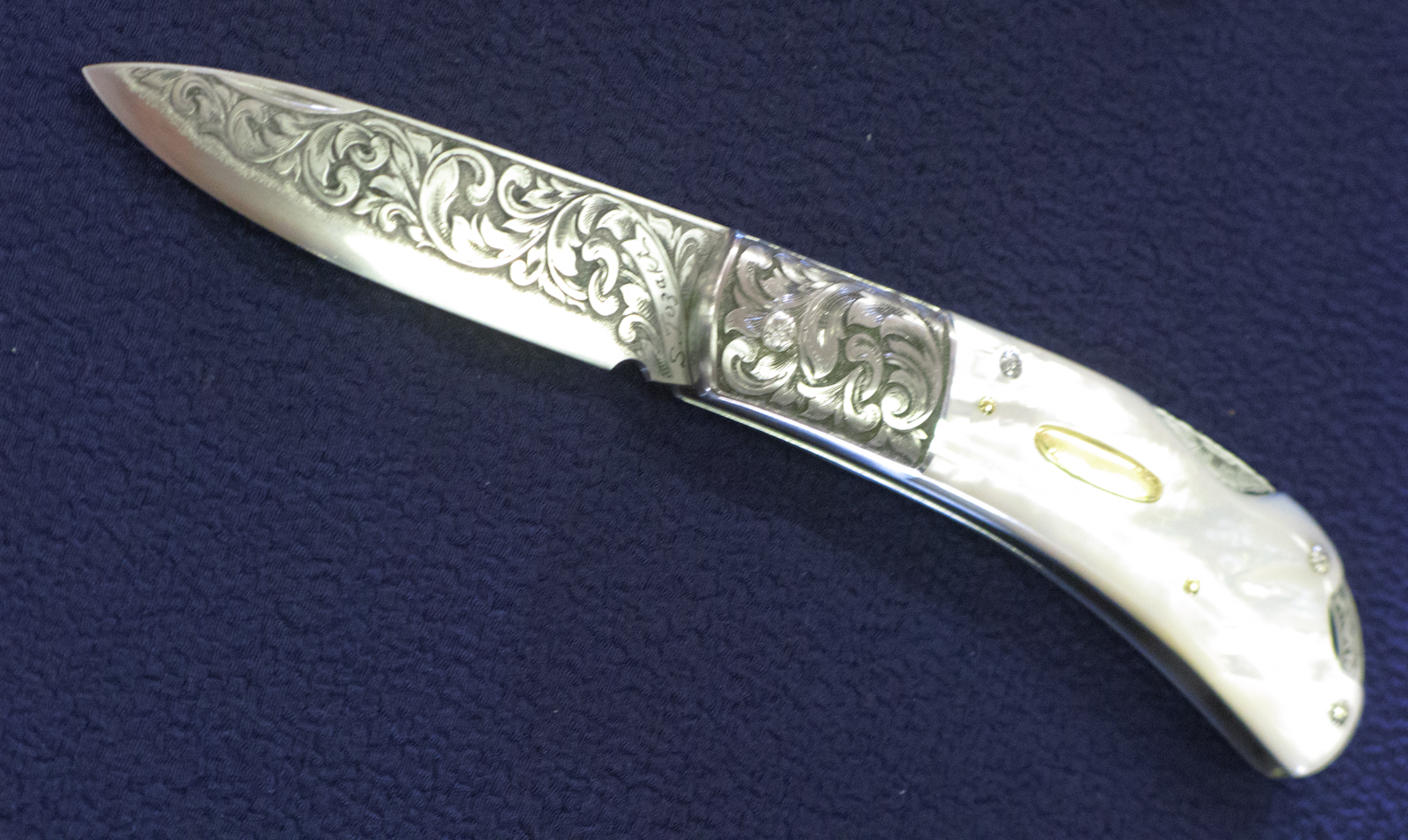
We then found ourselves the only foreign men in a room of Japanese and knives. We both were impressed with the friendliness of everyone at the show, both customers and knife makers. Some practiced their English; some were very patient with our Japanese; and none had problems handing us the pointy stabby things. That included a $6,600 knife which I was happy I neither dropped nor damaged. (The Canadian, it should be noted, refused to touch it.)

knifeshow-4

Yours for only $6,600.

In the end, we each acquired a damaged factory second from a maker who, in a move that seems backwards from usual business practices, offered DISCOUNTS when he saw our interest in his knives.

We were also impressed with the fact that the show existed. Japan has strict knife laws and much of what was being sold could only be carried if we had a “legitimate reason” for carrying it. Otherwise it could only be used at home.

There’s another show at the end of March. I suspect I’ll be there as it’s nice to be around people with similar interests. If I’m not, there, look for the Canadian.


Cross Counter Cultural Costco

One of the quirks of living and working overseas is that the newness of being overseas eventually wears off. At first you’re seeking out exotic foods (whoa, they totally don’t cook their fish here; they eat their rice PLAIN; rotting beans are totally a breakfast staple) and you make “you know you’ve been in ______ to long when” lists along the lines of “you know you’ve been in Japan too long when you apologize to the ATM for having to disturb it” or “you know you’ve been in Japan too long when the thought of eating cooked fish makes you sick to your stomach”.

After a few months, that joy of the exotic wears off and you begin eating at places you wouldn’t eat back home (McDonald’s and Starbucks) and Old El Paso Taco Kits and Red Vines become as valuable as gold. I’m convinced that if Yum! Brands (it’s real name) ever opens a Taco Bell in Tokyo, there will be blood as foreigners scramble for Doritos Locos Taco Supremes and Gorditas.

After having lived in Japan way too long I find I can now spot fresh foreigners as easily as I used to spot fresh students at university. When I worked as a trainer for my company I would usually announce lunch by explaining where the different options were. I’d add that I was going to Denny’s and it was certain that any trainee that joined me had lived in Japan for at least a year.

A few years back the Lively clan headed down to Chiba to raid a Costco for cookies, cookie mix, pancake mix, flour tortillas and coffee, lots of coffee. After conspicuously consuming, we were waiting for the shuttle bus back to the station when I overheard a couple foreign men talking about working for Fluor, a management contractor my father had worked for in the 80’s.

After the usual round of “small worlds” with the appropriate nods and “yep, sure is, sure iss” the older of the gentlemen, radiating the diaphanous glow of the exotic and the new, asked me where we ate when we came down “this way”. I said that we usually ate the pizza, hot dogs and chicken wraps at Costco. He looked at me, wide-eyed and confused, as if that concept were alien to him or had never occurred to him. He muttered something about how they’d found a little noodle place and that’s where they were heading.

To be courteous, I lied and said we’d have to check it out next time we came down “this way” but his brain was clearly still trying to process and grasp the notion of eating pizza in Japan at an American big-box store. (Shopping at an American big-box store in Japan was apparently normal, though.)

I didn’t have the heart to tell him that, even before I married a Japanese woman, I’d had my fill of soba, udon, somen, and ramen, cooked in ways varying from fried, to deep fried, to boiled, and had eaten more rice than I’d ever imagined I’d ever want. Sushi was basically fast food and could be had at any grocery store (including, it should be mentioned, Costco) for only a few dollars.

I eventually coaxed out that he’d been in Japan only a couple months and was going to be there for another year. I wished him the best of luck while secretly thinking “your time is coming. Your time is coming.”

I never saw him again, but I’m sure if I’d seen him a few months later he’d have been stuffing his face with pizza, hot dogs and chicken wraps while saving his Red Vines for dessert.